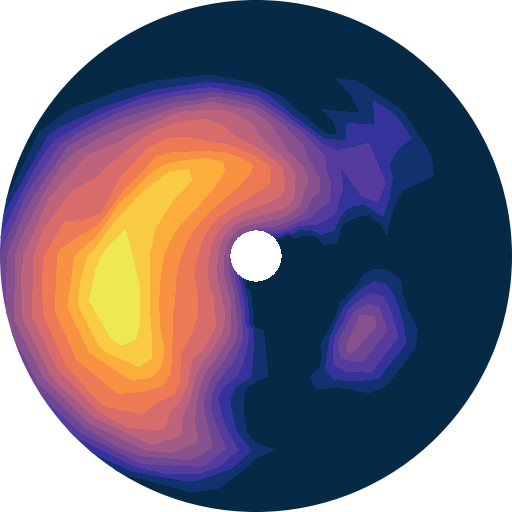
wavespectra.partition.partition.np_steepness#
- wavespectra.partition.partition.np_steepness(spectrum, spectrum_smooth, freq, dir, dpt=nan, scut=0.025, tail=False, swells=1, swell_merge='sum', ihmax=100)[source]#
STEEPNESS spectra partitioning on numpy arrays.
- Parameters:
spectrum (-) – Wave spectrum array with shape (nf, nd).
spectrum_smooth (-) – Smoothed wave spectrum array with shape (nf, nd).
freq (-) – Wave frequency array with shape (nf).
dir (-) – Wave direction array with shape (nd).
dpt (-) – Water depth, deep water approximation used if nan.
scut (-) – Wave steepness Hm0 / L cutoff, evaluated at the energy period Tm-1,0, at or above which a partition is classified as wind sea.
tail (-) – If True, account for an f^-5 high-frequency tail beyond the last frequency when evaluating the steepness.
swells (-) – Number of swell partitions to compute, all detected if None. The default of 1 merges all detected swells into a single partition.
swell_merge (-) – How to reduce more than swells detected swells down to swells partitions: “sum” adds the spectral energy of the smallest excess swells into the last (smallest) kept partition; “hp01” merges excess swells onto their closest neighbour using the Hanson and Phillips (2001) adjacency criteria. Ignored if swells is None. Either way, no swell energy is discarded.
ihmax (-) – Number of discrete spectral levels in WW3 Watershed code.
- Returns:
- Wave spectrum partitions sorted in decreasing order of Hs
with shape (np, nf, nd).
- Return type:
specpart (3darray)
Note
The smooth spectrum spectrum_smooth is used to define the watershed boundaries which are applied to the original spectrum.
Unlike ptm1, ptm2 and hp01, wind sea is identified from the steepness of each topographic partition rather than from a wind speed and direction based wave age criterion, so no wind input is required.