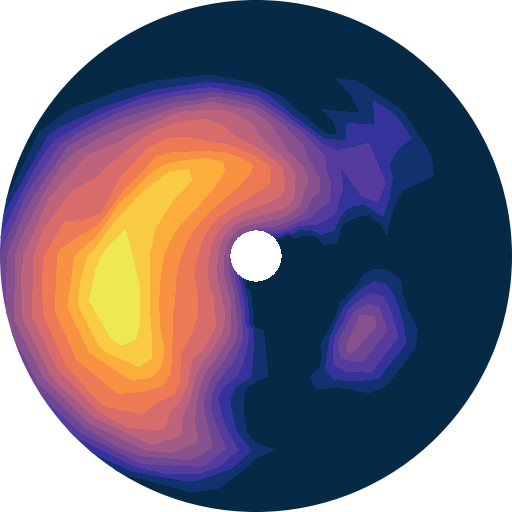
wavespectra.partition.partition.Partition.steepness#
- Partition.steepness(dpt=None, scut=0.025, tail=False, swells=1, swell_merge='sum', smooth=False, freq_window=3, dir_window=3, ihmax=100)[source]#
STEEPNESS watershed partitioning.
STEEPNESS works like PTM1 but identifies wind sea from the steepness Hm0 / L of each topographic partition, evaluated at the energy period Tm-1,0, rather than from the wind speed and direction based wave age criterion used by the other methods. Partitions with steepness at or above scut are aggregated and assigned to the wind-sea component (e.g., the first partition). The remaining partitions are assigned as swell components in order of decreasing wave height, merged down to swells partitions if more are detected (see swell_merge) so that no swell energy is discarded. The default swells=1 therefore returns a single wind sea and a single swell holding all the non wind-sea energy. Because no wind input is used, this method is useful when reliable wind speed and direction are not available, or when the misalignment between wave and wind direction is not a desired classification factor.
- Parameters:
dpt (-) – Depth DataArray, taken from the dpt variable in the underlying dataset if not provided, deep water approximation used if not available from either source.
scut (-) – Wave steepness Hm0 / L cutoff, partitions with steepness at or above this value are classified as wind sea.
tail (-) – If True, account for an f^-5 high-frequency tail beyond the last frequency when evaluating the steepness.
swells (-) – Number of swell partitions to compute, the default of 1 merges all detected swells into a single partition. If None, the number required to hold all swells detected from all spectra is used, which doubles the compute time and triggers an eager computation on dask datasets.
swell_merge (-) – How to reduce more than swells detected swells down to swells partitions. “sum” (default) keeps the swells - 1 largest swells individually and adds the spectral energy of the rest into the last (smallest) kept partition. “hp01” instead merges excess swells onto their closest neighbour using the adjacency, saddle-point and angle criteria from the hp01 method (Hanson and Phillips, 2001). Either way spectral energy is conserved rather than discarded. Ignored if swells is None.
smooth (-) – Compute watershed boundaries from smoothed spectra as described in Portilla et al., 2009.
freq_window (-) – Size of running window for smoothing spectra.
dir_window (-) – Size of running window for smoothing spectra.
ihmax (-) – Number of discrete spectral levels in WW3 Watershed code.
- Returns:
- Partitioned spectra with extra part dimension
where the 0th index are the wind sea and remaining indices are the swells sorted by descending order of Hs.
- Return type:
dspart (xr.DataArray, xr.Dataset)
Note
The steepness of a fully developed Pierson-Moskowitz sea is 0.035 in deep water regardless of the wind speed, and it grows as the sea gets younger, so a single scut threshold applies across the range of wind speeds. The default of 0.025 sits below the fully developed value to allow for the energy a topographic partition loses at its watershed boundaries.
The steepness of a wind sea partition is underestimated when its peak is close to the upper limit of the frequency grid, since the truncated energy is missing from Hm0. This affects light wind seas on the coarse frequency grids typical of wave model output, which may then fall below scut and be classified as swell. Set tail=True to compensate for the truncated energy; the correction is inert for swell partitions, which carry no energy at the last frequency.
The steepness is evaluated with the local wavelength when the depth is available, so shoaling waves become steeper in shallow water and swells may be classified as wind sea on that basis alone. Prescribe a larger scut or partition from the DataArray accessor without a dpt argument to classify from the deep water steepness in shallow water applications.
References
Hanson and Phillips (2001).
Portilla et al. (2009).
Tracy et al. (2007).
Vincent et al. (1991).
WW3 documentation (NOAA-EMC/WW3).